TEACH THEM BEFORE THEY NEED IT
A Love Moore Loudly initiative dedicated to bringing Social-Emotional Learning into our schools and communities.
We believe every child deserves the skills to understand their emotions, manage stress, and make responsible decisions.
Because prevention begins before the crisis.
WHY THIS MATTERS
Our children and young adults are navigating enormous amounts of pressure, stress, rejection, conflict and uncertainty while their brains are still developing.
The numbers tell us we cannot afford to wait until a young person is already in crisis.
We need to teach emotional awareness, coping skills, self regulation and how to ask for help before they need them most.
Prevention begins with preparation.
View CDC Suicide Data & Statistics →
https://www.cdc.gov/suicide/data/index.html?utm_source=chatgpt.com

THE TEENAGE BRAIN
Their brain isn't broken. It's still developing
The teenage brain is undergoing important development. The prefrontal cortex—an area involved in planning, prioritizing and decision-making—is one of the last parts of the brain to mature.Brain development continues into the mid-to-late 20s.At the same time, teenagers are navigating powerful emotions, relationships, social pressure, rewards and new experiences.That's why emotional regulation shouldn't simply be something we expect from young people.IT'S SOMETHING WE TEACH.SEL gives young people opportunities to practice:
🧠 Self-awareness — What am I feeling?
⏸️ Self-management — How can I slow this down?
💬 Communication — How can I express what I'm feeling?
🤝 Connection — Who can I turn to?
🎯 Decision-making — What could happen if I choose this?
The goal isn't to stop kids from having big emotions.It's to give them tools for what to do when those emotions show up.“I'm feeling something BIG right now.
I don't have to act on it immediately.”That's the pause we're trying to teach.

SEL isn't just about emotions. It's about giving young people skills for life.
Social-Emotional Learning helps children understand their emotions, manage stress, build healthy relationships and make thoughtful decisions.
CASEL identifies five core areas:
🧠 Self-Awareness — What am I feeling?
⏸️ Self-Management — What can I do with this feeling?
🤝 Social Awareness — How might someone else be feeling?
💬 Relationship Skills — How do I handle this with someone else?
🎯 Responsible Decision-Making — What could happen if I choose this?
These aren't just school skills. They're life skills.

THE PAUSE
Creating space between a feeling and a reaction.
Big emotions can make a young person feel like they have to react RIGHT NOW.
Anger. Rejection. Embarrassment. Fear. Heartbreak. Overwhelm.
We can't always stop the feeling—but we can teach young people how to create space between the feeling and what they do next.
That's where the PAUSE begins.
The Pause Tool
P — PAUSE
Stop. Breathe. Give yourself a moment.
A — ACKNOWLEDGE
What am I feeling right now?
U — UNDERSTAND
What happened? What triggered this feeling?
S — SELECT
What choices do I have? What could happen with each choice?
E — ENGAGE
Choose the healthiest next step—or reach out to someone you trust.
FEELING → PAUSE → CHOICE
The goal isn't to eliminate big emotions.
It's to create enough space to choose what happens next.
❤️ Teach them the pause before they need it.
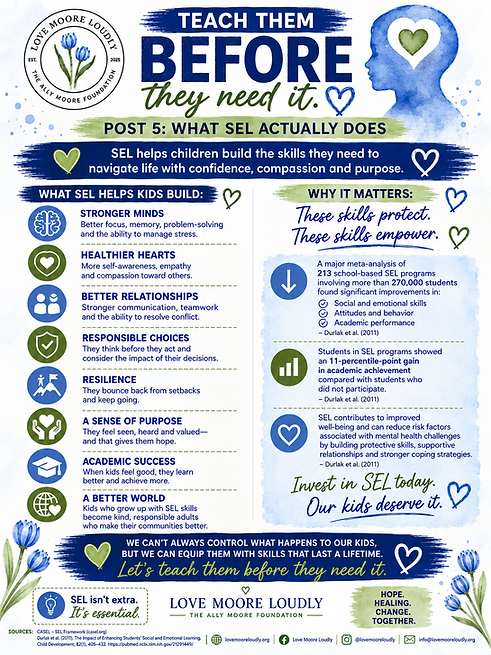
WHAT SEL ACTUALLY DOES
SEL isn't extra. It's an investment in skills children can use for life.
Social-Emotional Learning gives young people opportunities to develop skills that reach far beyond the classroom.
❤️ Emotional awareness
Recognizing and understanding what they're feeling.
🧠 Self-management
Managing stress, emotions and impulses.
🤝 Healthy relationships
Communicating, listening, cooperating and resolving conflict.
🎯 Responsible decision-making
Thinking about consequences before acting.
💪 Resilience
Learning how to navigate setbacks and keep moving forward.
📚 Academic success
Building social and emotional skills can support learning, classroom behavior and achievement.
THE RESEARCH SHOWS IT.
A major meta-analysis examined 213 school-based SEL programs involving 270,034 K–12 students.
Compared with students who did not participate, students in SEL programs showed significant improvements in social and emotional skills, attitudes, behavior and academic performance.
Academic performance reflected an 11-percentile-point gain in achievement.
WE CAN'T CONTROL EVERYTHING OUR CHILDREN WILL FACE.
But we can help equip them with skills for what they face.
❤️ Teach Them Before They Need It.
CONNECTION IS PREVENTION ❤️

Sometimes the most powerful thing we can give a young person is someone—and somewhere—to turn to.
Connection can look like:
❤️ A parent who listens.
🍎 A teacher who notices.
🏀 A coach who checks in.
🤝 A friend who reaches out.
🏡 A community where they feel they belong.
Young people need more than people around them.They need to feel seen, heard, valued and safe enough to ask for help.
WHY CONNECTION MATTERS
CDC research identifies school connectedness as an important protective factor for young people.
Students who feel connected at school are less likely to experience a range of health risks, including poor mental health, substance use and violence, and are more likely to have positive academic outcomes.School connectedness means a young person believes that adults and peers at school care about them as an individual and care about their learning.That matters.Because before a young person can say:“I need help.”They need to believe:“Someone will listen.”“Someone cares.”“I belong here.”“I don't have to handle this alone.”
SEL HELPS BUILD CONNECTION
SEL helps young people practice the skills that make meaningful connection possible:
💬 Communicating what they need
❤️ Recognizing emotions
🤝 Building healthy relationships
🫶 Showing empathy
🗣️ Asking for help
🌱 Developing a sense of belonging
EVERY CHILD NEEDS A PERSON
Every child needs a place where they know they belong.We may never know which conversation, teacher, coach, friend, parent or caring adult becomes someone's reason to reach out instead of shutting down.
❤️ Connection matters.Teach Them Before They Need It.
SEL IS NOT “SOFT.”
IT'S ESSENTIAL.
SEL isn't about lowering expectations for our kids.
It's about giving them the skills to meet those expectations.
SEL is not removing accountability.
It's teaching responsibility.
It's not telling kids they should never feel angry.
It's teaching them what to do with anger.
It's not eliminating conflict.
It's teaching them how to navigate conflict.
It's not preventing disappointment, rejection or failure.
It's helping them learn how to cope when those things happen.
WE CAN EXPECT MORE AND TEACH MORE.
We teach children:
📚 How to read.
➗ How to solve equations.
🔬 How to understand science.
🏃 How to take care of their bodies.
We should also teach them:
❤️ How to recognize emotions.
⏸️ How to pause before reacting.
🧠 How to manage stress.
💬 How to communicate through conflict.
🤝 How to build healthy relationships.
🎯 How to think through consequences.
🫶 How and when to ask for help.
ACCOUNTABILITY + SKILLS
We can hold young people accountable for their choices while also teaching them the skills to make better ones.
And finish with:
SEL ISN'T SOFT.
IT'S PREPARATION FOR LIFE.
❤️ Teach Them Before They Need It.

BRING SEL BACK
Into our schools. Into our homes. Into our communities.
We cannot wait until a young person is overwhelmed, in crisis, or facing a life-changing decision to begin teaching the skills they need to navigate it.
We have to teach them before they need it.
Love Moore Loudly is advocating for Social-Emotional Learning because young people deserve more than academics alone.
They deserve the tools to understand themselves, regulate emotions, communicate, navigate conflict, build healthy relationships, make responsible decisions and know when to ask for help.
🏠 PARENTS & FAMILIES
-
Talk about emotions at home.
-
Practice the PAUSE.Listen without immediately fixing.
-
Teach healthy coping skills.
-
Make asking for help normal.
🍎 EDUCATORS & SCHOOLS
-
Make SEL part of everyday learning.
-
Create spaces where students feel connected.
-
Teach emotional regulation and conflict resolution.
-
Give students language for what they're feeling.
-
Help normalize reaching out for support.
🏀 COACHES & YOUTH LEADERS
-
Remember that you may be a child's trusted adult.
-
Model emotional regulation.
-
Check in beyond performance.
-
Teach teamwork and healthy conflict.
-
Notice when something feels different.
🤝 COMMUNITY
-
Support youth mental-health education.
-
Create safe spaces for young people.
-
Partner with schools and families.
-
Support prevention before crisis.
-
Help make connection part of our culture.
THIS TAKES ALL OF US.
Parents. Teachers. Counselors. Coaches. Churches. Youth organizations. Community leaders. Friends. Neighbors.
Every adult who shows up for a young person has an opportunity to teach, model, listen and connect.
HELP US BRING SEL INTO OUR SCHOOLS & COMMUNITIES.
Love Moore Loudly wants to help make Social-Emotional Learning resources accessible to children, teens, families, educators and community organizations.
If you're a school, educator, youth organization, coach, parent or community leader interested in SEL resources or partnering with Love Moore Loudly, we want to hear from you.
HOPE. HEALING. CHANGE. TOGETHER.
❤️ Teach Them Before They Need It.
A Love Moore Loudly Initiative | The Ally Moore Foundation